


Recursive has released Flint, a local mixture-of-experts model built for fast agentic coding on local AI hardware. It contains 40 billion parameters but activates only 2.5 billion per token, cutting the computation required at inference. A small team of people and agents built it from scratch in under four months with help from the company’s automated research system, Eureka Machine.
Introducing Flint, @Recursive_SI’s first model: a fast local coding model built with our automated research system, the Eureka Machine.
— Richard Socher (@RichardSocher) October 21, 2026
• Best-in-class fast local coding
• Up to 2x faster than comparable models: 125+ tokens/sec on a MacBook Pro, 150+ on RTX Spark
• Built from… pic.twitter.com/ufg2xScSGw
Recursive says Flint leads MoE models below 50 billion total parameters on SWE-Bench Pro v2, Terminal-Bench 2.1 and SWE-Bench Verified. It also reports performance comparable to dense coding models with 25 to 40 billion parameters while running more than five times faster. With Recursive's optimized engine, Flint exceeds 125 tokens per second on an M4 Pro MacBook Pro and 150 tokens per second on a 64GB NVIDIA RTX Spark at short contexts. It supports up to 512k tokens of context, although Recursive recommends staying within 256k.
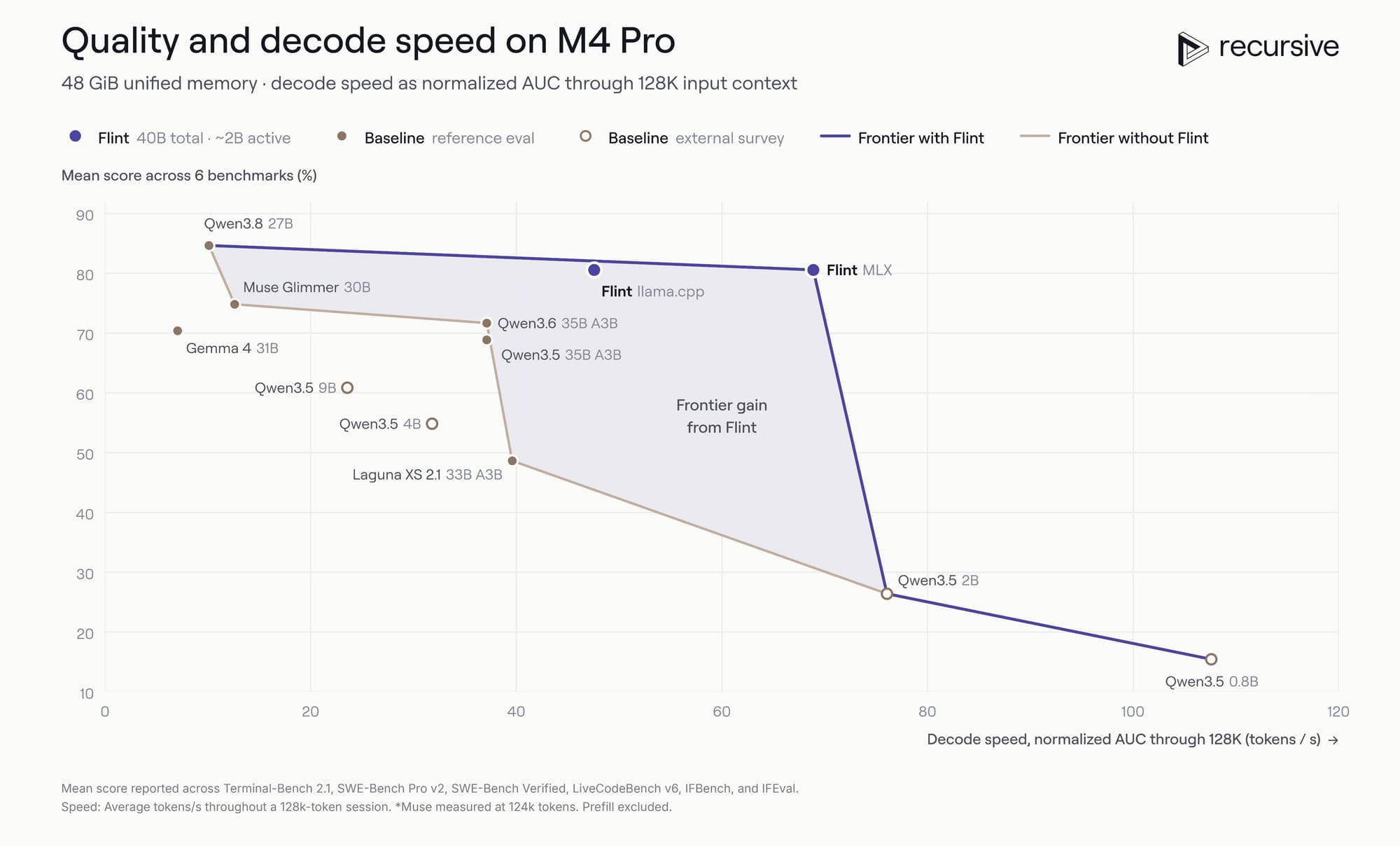
Flint targets developers who want coding agents that work offline, keep data on-device and avoid API fees. Recursive advises splitting complex work into smaller subtasks and giving explicit instructions, noting that the model may require more guidance than larger closed-source alternatives.
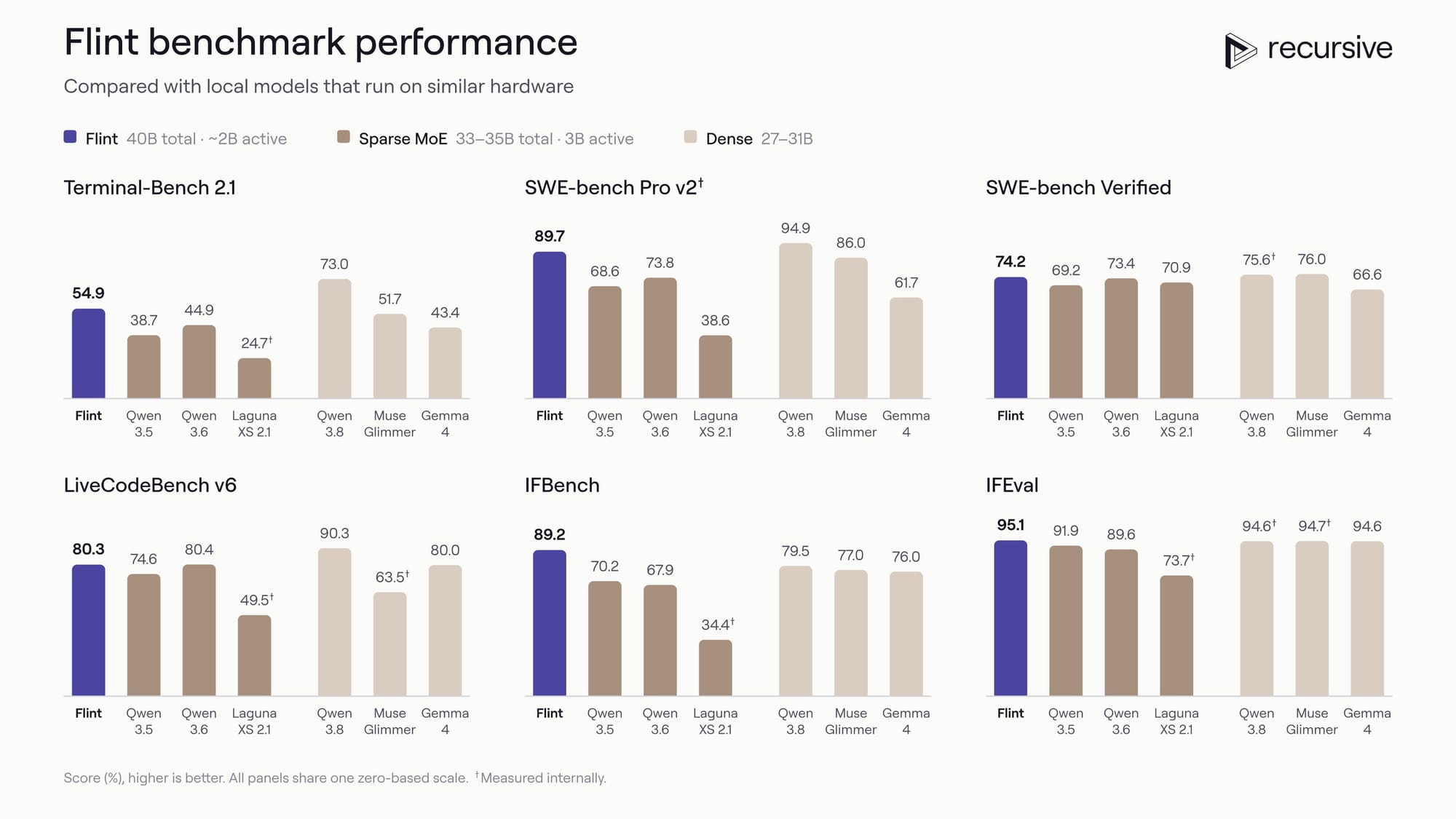
Eureka Machine helped develop Flint’s architecture, data, optimizers, training recipes, infrastructure, quantization and inference performance by proposing ideas, implementing them and testing the results. Its search moved from a 35-billion-parameter baseline with 3 billion active parameters to Flint’s 40-billion, 2.5-billion-active design. For quantization, it placed the output layer at four bits and used offline distillation with the 16-bit model as teacher. The resulting NVFP4 model scored within 0.7 points of the 16-bit version across Recursive’s benchmarks while nearly halving the training steps against its quantization-aware baseline.
Specialized kernels cover low-bit projections, MoE operations, attention and prompt processing, including a Metal megakernel that fuses the decode forward pass on M4 and M5 chips. Flint’s weights are available under Apache 2.0 and support llama.cpp, Ollama, Unsloth, LM Studio, vLLM and SGLang. Recursive is also releasing rec, an inference engine tuned for Flint on M4 Pro and M5 Pro or Max hardware.
Sources and related context
- Recursive Flint model card and open weights: Supports: The official model card confirms Flint's mixture-of-experts design, approximately 2.5 billion active parameters per token, and Apache 2.0 weight license.
- Recursive rec local inference engine: Supports: The official repository confirms rec supports M4 Pro, M5 Pro, and M5 Max Macs and provides local coding-agent setup instructions and hardware requirements.


