


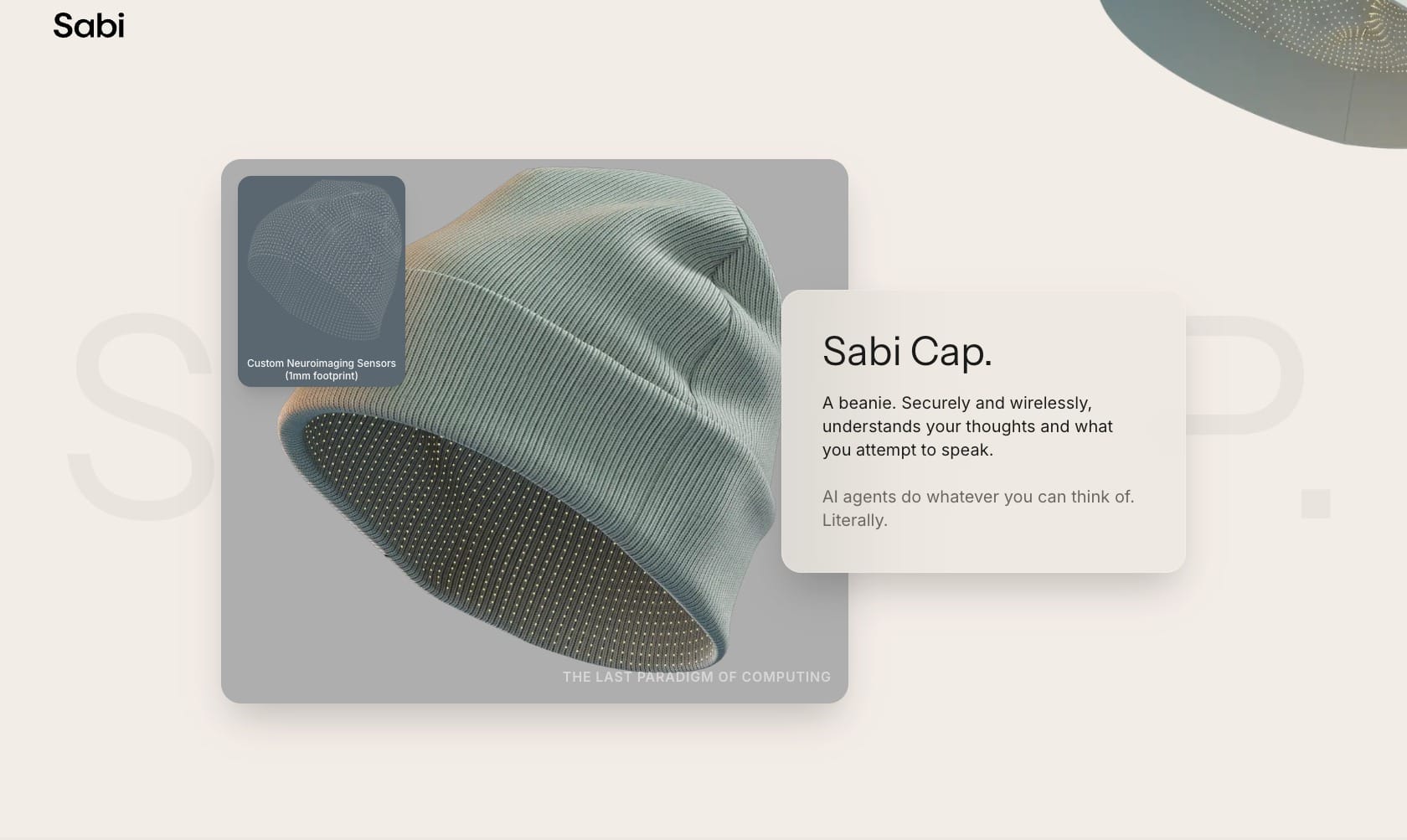
Sabi is building a brain-computer interface that fits inside clothing. Its first product, the Sabi Cap, is a hat lined with custom neuroimaging sensors that pick up the brain's electrical activity and decode internal speech, the words a person forms in their head without saying them, into text on a screen. No implant or surgery is involved, and Sabi is positioning the cap as an everyday input method for computers and AI tools.
The cap relies on electroencephalography, or EEG, which measures the faint voltage changes produced when large groups of neurons fire. Reading those signals from outside the skull is hard. After passing through bone, tissue, and hair, they arrive weak and blurred, and muscle movement and electrical noise can drown them out, which is why implanted electrodes have delivered the most accurate brain-to-text results so far. Conventional EEG also tends to need gel and electrodes pressed against the scalp, which rules out casual daily use.
we've raised $50M from Khosla Ventures, Accel, Initialized, Kevin Weil, DST Global
— Rahul Chhabra (@rahulchhabra07) October 9, 2026
to build the world's most wearable BCI cap at Sabi
read more here: https://t.co/5onHFJnEXU
Sabi's answer is to build the hardware itself. The company designs its own custom ASICs and sensors, and the centerpiece is what it calls the first non-contact EEG chip. Designed in-house and fabricated by TSMC, it reads brain signals without touching the scalp, and Sabi says it is low-noise and low-power enough to fit inside a cap. Reports from the April debut put the sensor count at 70,000 to 100,000, compared with the dozens or a few hundred channels of typical EEG systems. CEO Rahul Chhabra has said this density lets the system pinpoint where neural activity happens, giving the models cleaner data to decode.
The other half is software. Sabi trains its own Brain Foundation Model on neural data it collects itself, roughly 100,000 hours of recordings from about 100 volunteers at launch. The model is meant to learn patterns shared across many people, so a new wearer can use the cap without long calibration sessions before each use, a common pain point for existing BCI systems. The first version targets around 30 words per minute, and Sabi says the model can already predict a person's next three to four keystrokes from brain signals before they are typed.

Typing is only the starting point. Sabi is working toward thought-to-prompt, where a user thinks a request and an AI system receives it; models that adapt to each person's neural preferences; intent prediction; and intent-to-action, where an AI agent carries out what someone means to do. The company says it encrypts neural data in transit and trains its models on encrypted data, with outside neurosecurity experts involved. Independent, peer-reviewed performance data has not yet been published.
Check out the Sabi Cap
Sabi is a Palo Alto startup led by Rahul Chhabra. It came out of stealth in April with backing from Khosla Ventures, Accel, Initialized, and Kevin Weil, and a waitlist for the cap is open on its website. Pricing and a shipping date have not been announced.


